
About the Project
The Happy Planet Index is a measure of sustainable wellbeing, ranking countries by how efficiently they deliver long, happy lives using our limited environmental resources.
Rather than pursuing growth at all costs, even if it’s harmful to wellbeing or sustainability, what if we strived to create wellbeing and pursue sustainability, no matter the impact on growth? The Happy Planet Index (HPI) helps to answer the question: “Is it possible to live good lives without costing the Earth?”. It provides a compass to guide nations towards genuine progress.
The HPI was first developed in 2006 by Nic Marks and colleagues at the New Economics Foundation. It turned conceptions of progress on their head, ranking the small Pacific island nation Vanuatu as the country that came closest to achieving sustainable wellbeing at that time. It has been updated six times since then and received global acclaim and interest.
In the latest edition, we explore differences between men and women on the HPI and present individual level data based on the personal HPI survey.

“GDP forgot what it was for. It wasn’t about stability anymore, it was about something else. Growth? Power? But at what cost? And for whom?”
Watch the video to learn more.
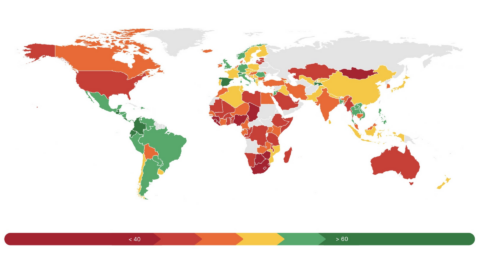
The 2026 HPI presents data up to 2025 for 134 countries.
As in previous editions, no country achieves sustainable wellbeing – that is, high life expectancy and high wellbeing within environmental limits.
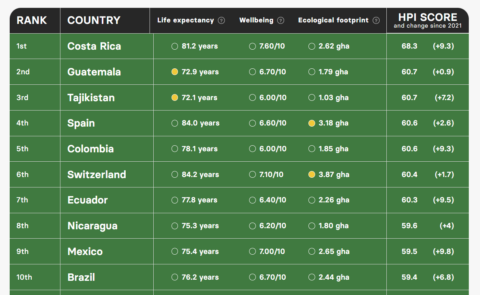
And the top 10 countries are not the wealthiest countries.
The HPI again highlights that the relationship between environmental impact and wellbeing is non-linear and inefficient.
Frequently Asked
The Happy Planet Index (HPI) combines three metrics to show how efficient different countries are at using environmental resources to enable their residents to lead long, happy lives.
- Wellbeing: How highly the residents of each country rate their lives overall, on a scale from zero to ten, based on data collected as part of the Gallup World Poll, and collated in the World Happiness Report.
- Life expectancy: The average number of years a person is expected to live in each country, according to the United Nations Development Programme (UNDP).
- Ecological Footprint: The surface area of the planet required to sustain a nation’s consumption patterns, in globally standardised hectares (g ha). Ecological Footprint Initiative. It includes land required to produce food and forest products, built-up land and land required to sequester carbon. Nations are assessed in terms of their consumption, not production.
We use a traffic light system – red, amber, and green – to show how well countries score on each element. Before combining the three metrics, we make adjustments to ensure that no single component dominates the overall calculations. Details can be found in the methodology report.
The crises we face: persistent inequalities, accelerating climate breakdown, and rapid biodiversity loss are interconnected and stem from the same core problem: our economies are structured, governed, and measured to promote economic growth over collective wellbeing.
Too often governments prioritise accelerated economic growth above all other concerns. They lose sight of what truly matters – long, happy, sustainable lives for people around the world.
No two nation’s economic systems are exactly the same, but they all operate on a similar logic: increasing Gross Domestic Product (GDP) is inherently good because it increases everyone’s wellbeing and prosperity.
In reality, GDP growth on its own does not mean a better life for everyone, particularly in countries that are already wealthy. It doesn’t take into account inequality, the things that really matter to people like social relations, health, or how they spend their free time, and crucially, the planetary limits we are up against.
Yes!
In this edition, we contrasted the HPI of men and women – both at the individual level, based on analyses of disaggregated data, and in terms of male and female leaders of nations. In both cases, we found an effect of gender on the HPI. At the individual level, women consistently achieve higher scores than men across the countries analysed, with differences of over 8 points in some countries. This is driven by higher life expectancy and significantly lower ecological footprints.
Meanwhile, when countries have female leaders, they have higher HPI scores, even when controlling for income, governance, and other factors. This shows how leadership and policy can influence sustainable wellbeing, with women leaders more likely to prioritise care-oriented policies and support climate action.
Not exactly. The point is not to replace one oversimplified single index designed by experts with another, even if the HPI does measure what actually matters. We think that we need to have a more nuanced approach, with a small set of 3-6 headline indicators replacing GDP, rather than a single index. And we think that citizens should be involved in deciding what those headline indicators are, at least when it comes to measuring the societal outcomes. To get a better sense of what we believe should supersede GDP, check out our work in Kerava, Finland and Recife, Brazil, running deliberative mini-publics (aka citizens’ assemblies) to define the good life and how to measure it.
How Happy is the Planet?
Check out all of the data on the Happy Planet Index website.
Explore hereAll Reports
Find the latest 2026 publication, and the previous 2024 report, here.
Who is working on Happy Planet Index




Related resources



Our Funders
