Image: Global Climate Revolution, André Oliveira Arruda, Brazil – Good Living 2050 Contest
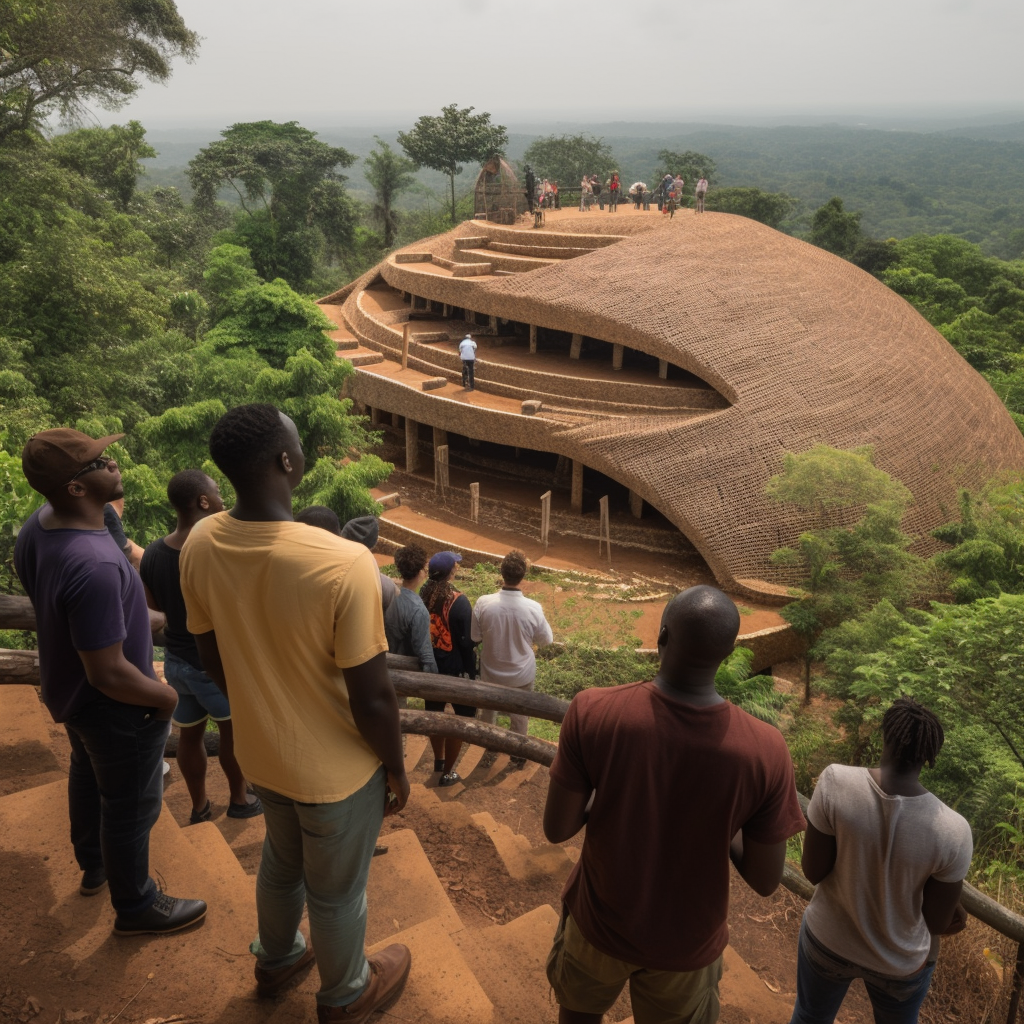
The room is alive with conversation, as participants from around the world explore images of possible futures. I’m leading a workshop on Reimagining Global North Lifestyles at the 2025 TED Countdown Summit in Nairobi, Kenya. When I ask participants what they’re drawn to, they overwhelmingly select ‘nature-positive’ images – re-wilding in cities, rooftop farm innovation, nature-based community hubs, and green ‘vertical villages’ in skyscrapers. The message is clear: “We want a future where humans and nature are deeply interconnected”.
A nature-positive future is one in which our own wellbeing improves while Earth’s ecosystems – and the diversity of life they support – recover and thrive. Achieving this requires new visions of ‘good living’ based on health, resilience, equity, sufficiency, and care for ourselves, each other and the natural world.
How can nature-positive living become more accessible – even the default – for more of us? One clear way is to make it part of our dreams and our vision of the ‘good life’.
A new report by Hot or Cool Institute highlights the critical role that ‘aspirational systems’ play in enabling nature-positive living. These systems include the cultural values, social norms, and status signals that define what’s seen as a desirable lifestyle. They are shaped by institutions, the media and cultural dynamics and “play a central role” in influencing consumption choices and everyday behaviours. “Transforming aspirational systems is therefore crucial to making nature-positive lifestyles more attractive, desirable and accessible to all.”
Getting to a nature-positive world is itself an aspiration. In 2019, a coalition of sustainable business and finance leaders, conservation groups, and scientific and Indigenous knowledge networks came together to conceptualise this goal, with a commitment to galvanize international action to halt biodiversity loss and recover nature by 2050. The aim is restoration and regeneration – not just stopping harm. It’s about measurable gains in resilience, health, security, equity, and community at all levels, from society to our everyday lives.
Here are five ways we can make nature-positive living our collective aspiration:
- Reinforce values around nature-connectedness.
People deeply value the natural world. Human-nature connections cut across age, political affiliation, gender, and regions, including in the United States. However, a recent study of 61 countries reveals that the Global North has experienced a 60% decline in the human-nature relationship since the 1800s. Drivers include growing urbanisation as well as the Western worldview – which separates humans from nature – as compared to traditional cultural and spiritual values in the Global South, where nature-connectedness remains strong.
We can learn from the cultural strengths of the Global South and embrace policy shifts that centre nature-connectedness. Nature’s value is also overlooked in education and should be reframed as core to leadership with natural systems being the foundation for economies, jobs, wellbeing and community resilience. Hot or Cool’s Nature-Positive Lifestyles report highlights how values and societal narratives can be re-designed around nature-connectedness in important lifestyle domains such as food, mobility, housing and consumer goods. This includes ‘choice-editing’ or making sustainable choices the default, and policies to reduce meat and fish consumption and wasted food, increase active and shared mobility, and promote smaller, nature-positive living spaces, and support repairable and circular consumer goods.
- Unleash our imagination, including through the arts and in our social networks.
In 2016, Indian novelist Amitav Ghosh highlighted our collective inability to respond to ecological decline as a ‘crisis of the imagination’. Globally, powerful forces are battling for our imagination – contributing to contested aspirations. Visions of Mars colonization and techno-amped sustainable abundance stand in stark contrast to centring Indigenous worldviews of care, stewardship and reciprocity.
We need ways to envision compelling alternatives of nature-positive societies and lives in all their diversity, to drive social transformation and scale behaviour change. This visioning is most effective in groups and trusted communities. Transition Network founder and author Rob Hopkins asks us to deep dive into radical imagination. His experiments in time travel meditations lead people to fall in love with the futures they imagine. Hopkins invites us to ask ‘what if’ questions and create longing – a deep imaginative craving for a sustainable, resilient and beautiful world that compels collective action. Artists, storytellers, designers and creatives are powerful allies in unleashing the imagination with their capacities for ‘world-making’ and directing attention and expression.
- Reveal the absurdity of the present.
Part of sparking imagination is to raise questions about the world we’re in. Scholars Maarten Hajer and Jeroen Oomen call this defamiliarization: revealing the absurdity of the present and creating tension around what’s seen as ‘normal’ to shift values and mentalities. We need to un-imagine the present and investigate the deep set of beliefs about how society works. Donella Meadows identified this as the highest leverage point in catalysing societal transformation.
Through targeted engagement campaigns, we can ask questions about the problematic nature of consumption patterns we may take for granted: Why are we being wasteful? Why is flying so cheap? This prevents us from accepting current norms as natural or inevitable, revealing them instead as practices we can change, and allowing alternatives to gain traction.
- Regulate and redirect marketing and advertising.
Global spending on advertising – from the media to ads at schools, sports and music events – topped $1 trillion in 2024 and is growing, shaping our needs and aspirations and creating feelings of scarcity. As of 2025, only around 6% of ads depicted sustainable behaviours. However, efforts to ban harmful advertising and to reduce the influence of ads, including on children, have surged. Some advertisers and marketers are shifting the industry by ‘changing the brief’ and envisioning sustainable ways of living (e.g. Good Life 2030).
- Interconnect aspirational systems and provisioning systems.
The Nature-Positive Lifestyles report highlights how aspirational systems are interdependent with the sustainable ‘provisioning systems’ that we need to establish to meet people’s needs. Provisioning systems are the ways in which food, housing, mobility and goods are designed, produced, traded, distributed, priced and made available.
“Changing aspirations without transforming provisioning systems can create practical barriers to behaviour change”, the authors note. “Conversely, reforming provisioning systems without shifting aspirations may lead to social resistance or backlash.”
Building coherence between the two systems requires coordinated action across public, private and civic actors, guided by shared visions of ‘good living within planetary boundaries’. To strengthen this alignment, policies can promote inclusive participation, narrative change and cross-sector collaboration.
“Only by integrating structural reform with cultural renewal can societies achieve the scale of transformation needed to make nature-positive lifestyles the norm rather than the exception”, the report concludes. Read more about these systemic connections in this blog by Hot or Cool’s Dr. Lewis Akenji here. Acknowledging this interdependence is critical as we aspire towards sustainable, thriving everyday lives for all.