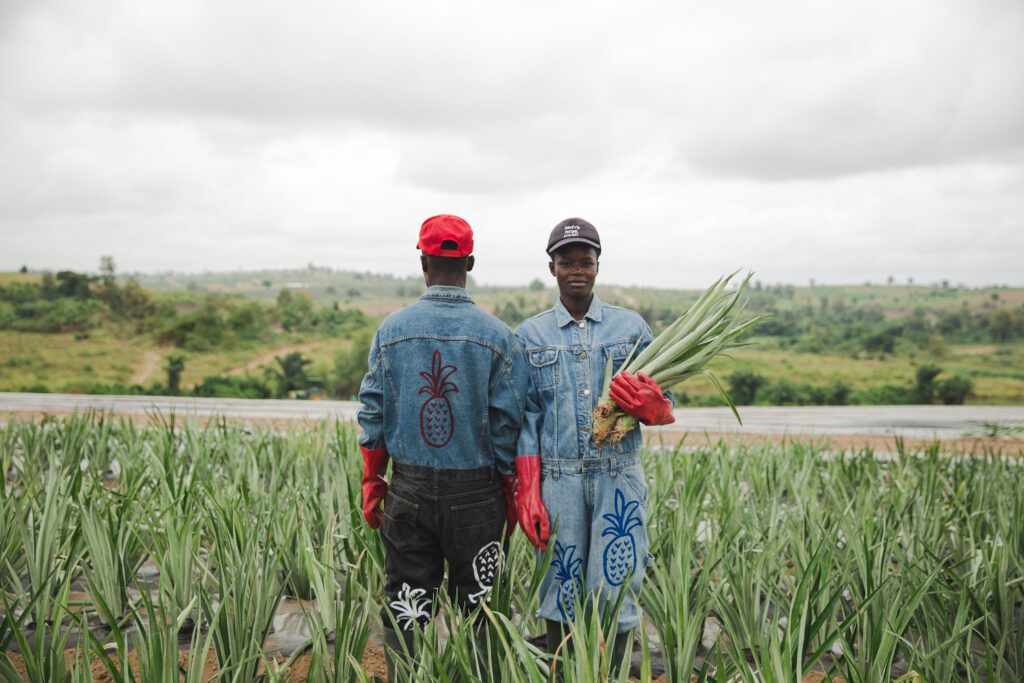
In the early morning heat of Kantamanto, one of the world’s largest second-hand clothing markets, in Accra, Ghana – a young farmer is purchasing used clothes to take to a pineapple plantation, where he and his colleagues put them on, layer by layer. It’s the only way they know to protect their skin from the sharp spines of the fruit as they work.
Yayra Agbofah, the founder of The Revival, an Accra-based label working at the intersection of fashion, waste, and community, saw this and didn’t look away. Instead, he started to ask questions. What he found became the foundation of a design philosophy and a challenge to mainstream fashion business models.
Agbofah has been embedded in Kantamanto since 1998, first as a trader, now as a designer and global advocate for sustainable fashion. Over that time, he has watched the global sustainability conversation evolve and noticed something troubling about it.
“Many interventions, even the well-intended ones, are disconnected from the day-to-day realities of traders, tailors, and players within the market ecosystem,” he says.
So Agbofah stopped listening to the global narratives around sustainable and circular design and started listening to the people in his community. What do people actually need? And what systems are already in place to meet those needs?
The pineapple farmer’s improvised uniform was, in its own way, a design solution, just an uncomfortable one. Five or six layers of light fabric offered enough protection, but the heat was brutal and ultimately the solution was not durable so the layers often had to be replaced. When Agbofah saw the pineapple farmers returning to the market frequently to buy more garments for work, he saw a problem worth solving.
He went to the archives, researched historical workwear from India and Indonesia, tracing the design logic of the overall, a garment built for protection, durability, and ease of movement. He looked at the waste streams flowing through Kantamanto and noticed that denim made up a significant proportion. A heavy, strong, abundant, and largely unsellable fabric within the market, he realised denim could do in one layer what the farmers were doing in six.
But here’s where needs-led design diverges most sharply from standard practice in the fashion industry. Agbofah brought the farmers in. Not as recipients of a finished product, but as co-designers. The farmers told him what they needed around the shoulders, how deep the pockets should sit, where ventilation mattered most. Someone suggested punching holes in the armpit area to help with airflow in the heat. The garment evolved with them, not for them.
“That is the actual way to design,” Agbofah says. “If you’re designing for somebody, you need to have that person in mind and have their input.”
The result is a farm uniform that protects its wearers, is made from waste fabric that would otherwise be discarded and is owned, emotionally as much as materially, by the people who use it. Agbofah describes how that sense of ownership changes the relationship between a person and their clothing. “I don’t think you would design something and be proud of that designand throw it away after one or two uses. Even if it’s stained, you would try to wash it. If it’s a broken button, you try to fix it, because your creativity is embedded within that product.”
This is the longevity and emotional durability that the sustainability sector has been trying to engineer through complex product criteria, eco-labels and awareness campaigns. Agbofah suggests it emerges naturally when people are genuinely involved in what they wear.
The fashion industry’s default mode is to design first and then engineer desire through marketing and advertisement, hoping to find a consumer later. What Agbofah practises is the opposite. He locates a genuine human need, understand the systems and materials already available, and works with the people at the centre of it.
But when asked about how this alternative design philosophy can bring to fashion Agbofah’s message is clear and offers a diagnosis that cuts deeper than most sustainability frameworks dare to go.
“We have a business model problem pretending to be a design challenge.”
This is a hard truth for the industry to sit with. It means that better-designed sustainable products, however thoughtfully made and circular, cannot fix a system structurally built to overproduce.
From his perspective in Kantamanto — where millions of garments from across the world arrive each week, many of them unsellable. ‘Design is not the engine of the problem, it is the amplifier’, currently used to stimulate desire, justify constant newness, shorten the perceived lifespan of garments, and obscure what happens to garments at the end of their life.
“If the business model changes,” he says, “then design becomes a powerful tool for longevity, for repair, for reuse.” But until it does, design improvements are being absorbed into the same dynamics that created the crisis.
For Agbofah, the path forward requires policy that is clear-eyed about this, interventions designed not to manage the symptoms of overproduction but to fundamentally change the business model that drives it.
When asked what gives him hope in the context of mounting textile waste and environmental crisis, Agbofah doesn’t reach for optimism, he reaches for evidence.
He points to the traders and tailors and upcyclers who create value from what the industry discards every day, without waiting for policy frameworks or innovation labs. “Kantamanto is already a circular system,” he says. “It’s just under-resourced.” In terms of what he is building at The Revival, a lab for need-centred community design, a repair atelier, a growing body of proof that alternatives are not hypothetical. “I’m not waiting for the industry to fix itself,” he says. “I’m building what it should have been.”
He points to the slow but real shift in the questions being asked. In recent years the conversation has moved from not just how do we recycle more, but why are we producing this much and who is carrying the cost. And this shift matters.
And he points to the fact that voices from places like Kantamanto are being heard in the rooms where decisions are being made. Last year, Time Magazine named Agbofah one of the 100 most influential climate leaders in the world. The week we spoke, he was preparing to present to heads of state. For Agbofah, the fact that the people closest to the reality of fashion’s impacts are no longer being spoken about but spoken with- is a clear sign of progress.
Fashion has spent decades asking what people desire. Yayra Agbofah is asking something harder, more grounded, and essential for navigating our future: what do people actually need and what materials and systems exists that could serve it?