Inside the report
The report addresses four key questions:
First, what does it mean to integrate wellbeing into Europe’s circular economy in line with EU priorities on competitiveness and security, and how can wellbeing provide direction to circular strategies?
Second, why have circular economy and wellbeing economy agendas developed largely in parallel, and how does this limit their transformative potential?
Third, how can circular strategies deliver wellbeing outcomes in practice through an integrated framework linking circularity’s “R-strategies” with wellbeing principles?
Fourth, which policy options can better align Europe’s circular transition with wellbeing for all, strengthening both environmental and climate outcomes and social legitimacy?
Key insights
Despite ambitious EU policies and legislation, progress towards the 2030 circular economy targets remains slow. Current approaches focus heavily on recycling and waste management, while higher-impact strategies addressing production, consumption and material use receive far less attention.
A wellbeing economy shifts the focus of economic success from growth and consumption towards quality of life, social equity and ecological health. Circular solutions gain broader public support when they improve people’s daily lives through lower living costs, better housing, cleaner air, accessible mobility and quality local jobs. In this approach, circularity becomes the means to achieve wellbeing outcomes.
The strongest synergies between circularity and wellbeing emerge in the “before-use” phase through strategies such as refuse, rethink and reduce. These approaches prevent environmental and social harms early while opening space for new business models and more sustainable lifestyles.
Strategies that extend product lifetimes are labour-intensive and locally rooted. They can generate meaningful employment, strengthen local economies and distribute economic benefits more fairly across communities.
The report proposes four additional strategies: Reimagine, Retell, Relocalise and Reconnect.
- Reimagine — redefining what a good life means, shifting aspirations from accumulation towards care, connection and belonging
- Retell — redirecting advertising, marketing and social media narratives away from overconsumption
- Relocalise — shortening supply chains and anchoring circular practices in local communities and ecosystems
- Reconnect — strengthening relationships among people, between people and nature, and between citizens and their cultures
Together with the existing circular economy approaches, they create a broader framework for a wellbeing-oriented circular economy centred on culture, community and quality of life.
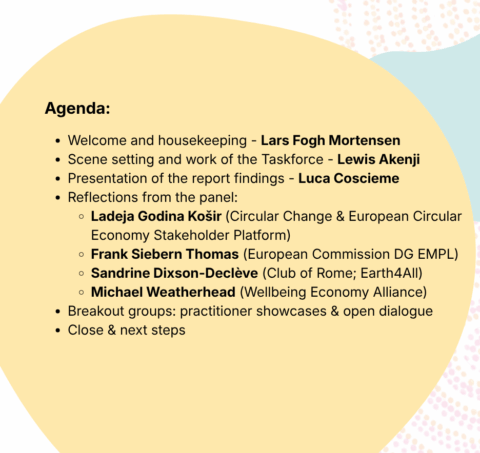
Report Launch Webinar
Find the webinar presentation slides here.
Ways Forward
To move from theory to practice of advancing a Circular Wellbeing Economy, six focus areas were identified by a high-level expert group convened by the EEA in January 2026. Policy and governance frameworks, academic research, measurement systems, and practical experimentation by firms, citizens and local communities each generate valuable insights. When these domains are connected through strong communication and movement-building, they create a shared knowledge base capable of accelerating innovation, improving policy design and strengthening collective ownership of the transition.
Reaching Europe’s 2030 circular economy targets will require a shift in policy focus from end-of-life waste management towards upstream interventions in production design and consumption patterns. Integrating wellbeing objectives into existing governance frameworks offers a practical pathway to broaden public support, improve policy coherence, and strengthen the overall effectiveness of the transition to a more resilient, socially just, and therefore competitive Europe.
Support our work
Hot or Cool Institute produces evidence-based research to inform policy, shift social norms, and promote low-carbon, nature-positive lifestyles. All our work is freely accessible and open source, ensuring that anyone can use our research, tools, and guidance at no cost.
We rely in part on public support to sustain our non-profit activities, expand research, and keep resources freely available. Your contribution helps us reach more people, influence more policies, and accelerate systemic change.
If you share our vision, you can support us here.
Partners